What Neptune says in your birth chart
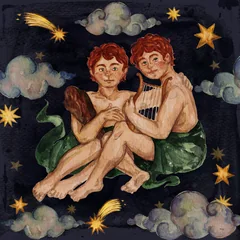
Neptune is where your life loses its outline. It is the area where you idealise before you look, where the border between you and the other grows thin, and where inspiration and deception come through the same door. And it is, for the same reason, the area where you are disappointed with a regularity that is not bad luck.
Before any description, the same caveat that opens the Uranus series, and here it weighs even more: the sign of Neptune is not yours. It belongs to your generation. It stays about fourteen years in each sign and takes a hundred and sixty-five to go all the way round, so everyone born in the same fourteen-year span as you has exactly this same Neptune — twice the span of Uranus.
The consequence is hard and it is honest: on its own, the sign of Neptune does not describe you. It describes what your whole generation idealised — and it is a reading of history, not of personality. What individualises it is the house it fell in, which depends on the exact hour of birth, and its conversation with the rest of the chart.
And there is a clock here, and it is the sibling of the Uranus one: the square of Neptune, around the age of 41. That is when it reaches ninety degrees from the point it held at your birth — a quarter of the turn —, and it falls practically together with the opposition of Uranus. It is no coincidence that the midlife crisis is famous for being two things at once: a rupture you can see, and a disillusion you cannot name.
What it means to have Neptune in Gemini
Having Neptune in Gemini meant that that generation idealised the word and the news. Gemini is mutable air, ruled by Mercury — speech, news, exchange. Neptune there dissolves the outline between what is said and what is: it is the generation in which information became, for the first time, something to be consumed.
Anyone born between 1889 and 1902 grew up with the cheap newspaper, the telegraph and the first cinema, and was the first span to live inside a quantity of news larger than one person's life could hold. It was also the generation that war propaganda reached first.
And here is what hardly any text writes down: this is the only page in this series that speaks in the past, and it has to. The youngest person with this Neptune was born in 1902. Writing in the present about a span that is gone would be false, and so this text tells what happened to it — which is exactly what the next one, in 2052, will be able to consult.
It is worth repeating this series' caveat before going on, because the span here is twice that of Uranus: this sign belongs to your generation, and not to you. Neptune passed through Gemini from March 1889 to May 1902 and only returns in 2052 — it is the only span in this series whose generation is entirely gone. What is described above is what that whole span idealised. What makes it your story is the house Neptune fell into. In the 3rd house that became someone who lived by writing; in the 9th, someone who carried an idea far from where it was born.
How Neptune in Gemini shows up day to day
It showed up in the distance between what that generation believed it was reading and what was written. These are concrete signs, the kind you recognise in your own week:
- was the first to live with daily news at home
- idealised the printed word and what it promised
- confused what was written with what was
- produced a literature that distrusts its own language
- was hit squarely by war propaganda
- treated conversation as an art form
Notice what that list does not say. It does not say the person was gullible or shallow — two labels this position carries that describe the excess, not the position. It says that generation dissolved the border between informing and convincing.
What are the strengths of Neptune in Gemini
The strength was the inspired word: that generation wrote like nobody before it. It was the span that produced much of modern literature, and that is no coincidence: a generation that idealises language also discovers what it cannot say.
In practice that becomes three useful things: a rare sensitivity to the written word; an ease in learning languages and in translating worlds; and a useful distrust of rhetoric, learned the most expensive way.
That strength does best in literature, translation, journalism, teaching and any arrangement where language is the material. And it did badly in an environment that demanded obedience to a single discourse, and anywhere asking questions was treated as disloyalty.
What are the challenges of Neptune in Gemini
There are two, and they are opposites: the excess is the idealisation of the word turning into credulity, and the deficiency is the person who killed their own ideal so as not to be disappointed again. The Shelly Method reads every archetype through four faces — the light, the shadow, the excess and the deficiency —, and in Neptune there is a difficulty the other planets do not have: from the inside, the two faces are indistinguishable. Inspiration and deception give exactly the same sensation at the time; the difference only shows up in the result, months later.
The excess was believing what was written because it was written. A whole generation was talked into marching by newspaper text, and the cost of that is the history of the last century.
The deficiency is the opposite and passes for lucidity: the person switched off their capacity to imagine and calls that realism. And the opposite showed up later, in the same span: total disbelief, the certainty that nothing one reads is true. Whoever went through 1914 switched off the capacity to believe anything said, and that is a loss too.
Both faces have the same raw material, and that is why the repair is the same: a word that needs a source, not less imagination. It was not solved by distrusting everything — distrusting everything is the second face. It was solved the same way as today: by asking who wrote it, and why — and that is what the house of Neptune and the rest of the chart show.
These two challenges do not show up the same way in two people with Neptune in Gemini — and since this sign belongs to a whole fourteen-year span, the difference between them lies entirely in the house, in the retrograde and in the rest of the chart.
See this in my chart, freeHow Neptune in Gemini evolves over time
It matured when the word gained a source — and that was worth more than any attempt to read less. Imagination remained the talent; what changed is that it stopped being an open door for whoever wanted to come in.
And here there is a clock almost nobody names: the square of Neptune, around the age of 41. That is when it reaches ninety degrees from the point it held at your birth — a quarter of the hundred-and-sixty-five-year turn —, and it falls practically together with the opposition of Uranus. That generation lived it around 1930, and it came together with the crash and the decade that followed.
That is why the midlife crisis is famous for being two things at once: a rupture the person sees and can recount, and a disillusion they cannot name. The first belongs to Uranus; the second to this square, and it is usually the one that hurts more.
Maturity there was not reading less. It was telling apart what the person knew from what they had read. The mature Neptune in Gemini went on imagining, and came to ask where what they read came from — and it is that question that turns rumour into knowledge.
No honest text gives an exact age for this: the arc depends on the whole chart.
What Neptune in Gemini does not say about you
It says what your generation idealised, not who you are. It is the most important difference in this whole series: a text describing this position as a personal trait would be selling as yours a climate that fourteen whole years of people share.
And it is the LEAST personal piece of your chart: tens of millions of people born in the same fourteen-year span have this same Neptune. What individualises it is the house, which depends on the exact hour: Neptune in Gemini in the 3rd house became someone who made writing their whole life; in the 10th, someone whose career depended on convincing. See the series Neptune in the 12 houses, which is where this reading becomes yours.
And there is Saturn, which is the exact counterweight to Neptune: one gives outline, the other dissolves it. Reading the two together separates a sensitivity that produces something from one that only tires. See also Uranus and Pluto in the 12 signs, the other two planets of your generation, and The Sun in the 12 signs, which the date makes truly yours.
A limit said out loud, because it is also part of reading seriously: none of this is prediction. Astrology describes a tendency and gives vocabulary for what the person already lives — it does not replace your work or your decisions.
Frequently asked questions about Neptune in Gemini
How do I find out which sign my Neptune is in?
By date: Neptune stays about fourteen years in each sign. The dates here mark the continuous passage — at the turns it enters, goes retrograde and enters again, and the coming and going lasts months, so anyone born near one of them needs the calculated chart. On its own, it says little: the personal part is in the house, and the house requires the hour.
Is Neptune retrograde in the birth chart a bad thing?
No, and almost half of all births have Neptune that way — it is practically a routine condition, not an exception. What changes is the direction: instead of projecting the ideal outwards, the person keeps it inside. They tend to be disappointed less by others and more by themselves, and to take longer to admit they idealised something.
Is there still anyone with Neptune in Gemini?
No. The span runs from March 1889 to May 1902, so the youngest person with this Neptune was born more than a hundred and twenty years ago. The next passage begins in 2052. This is the only page in this series written entirely in the past, and that is deliberate: pretending the present here would be false.
Why read a page about a generation that is gone?
Because it shows the mechanism working from beginning to end, which no living span allows. You can see what that generation idealised, what it cost and how it aged — and it is the most useful reading there is for understanding what Neptune does in a sign.
Is Neptune the planet of illusion?
It is the piece tradition calls that, and the word tells half the story. Neptune dissolves outline, and dissolving outline is what produces both compassion and deception — the same door. Without it there would be no art, no empathy and no faith; with it in excess, the person cannot tell what they feel from what they imagined. Calling that only illusion throws away the half that holds up a great many people's whole lives.
Why does this sign say so little about me?
Because it belongs to your whole generation, and that is the honest answer. Neptune takes fourteen years in each sign, so this text describes a climate that tens of millions of people share with you. The personal part is the HOUSE it fell into — which depends on the hour of your birth — and the way it talks to the Sun, the Moon and the Ascendant. A text promising more than that would be selling what it does not have.
Neptune in Gemini in short
Keywords word, news, imagination, rumour
This one cannot be found from the date: the Moon changes sign every two and a half days, more or less. Two people born on the same day can have different Moons — it depends on the TIME. Without a birth time there is no Moon, and that is why the chart asks for date, time and city. You can calculate it for free here.
See your whole chart, for free
Sun, Moon, Ascendant, the planets, the houses and the aspects calculated from your date, time and city of birth. It takes less than a minute.
Generate my birth chart for free Want the written reading of the whole? Personality and essence crosses Sun, Moon and Ascendant instead of describing each one separately.