What the houses represent in the birth chart
The sign says HOW, and the house says WHERE. Two people with the Moon in Cancer can have emotional lives that look nothing alike: one with the Moon in the 3rd house, who calms down by talking; another with the Moon in the 12th, who only calms down when there is nobody else around. The way of feeling is the same. The place where calm is sought is not.
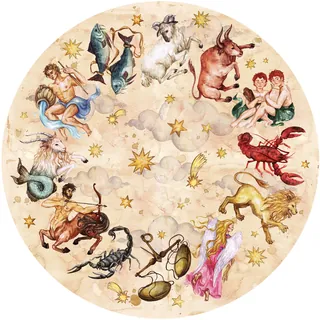
The twelve houses are the twelve areas in which life happens — the body, money, conversation, home, creation, work, partnership, what is shared, meaning, career, the group and withdrawal. The Moon falls in one of them, and that is the area the person runs to when the day goes wrong.
And here is what separates this series from every other one on the blog: the house is the piece of the chart that depends most on the time of birth. The twelve houses are counted from the Ascendant, and the Ascendant changes roughly every two hours and depends on the city. With no time and no place there is no house at all — not even an approximate one. That is why hardly any site talks about houses: it is work, and it means asking for more than the date.
What it means to have the Moon in the 4th house
Having the Moon in the 4th house means that feeling and belonging are the same thing for you. This is the position where the Moon is at home: the 4th house is its natural domicile, and here everything the Moon does is done at full volume.
The 4th house is the root — the family one comes from, the address, the ground, what is left when everything ends. With the Moon there, this person's state of mind is a thermometer of the domestic environment: house at peace, person at peace; house in conflict, person with no ground.
And here is what hardly any text writes down: the emotional climate of the house this person grew up in is not background, it is their operating system. They repeat that climate without choosing — in the way of arguing, in the dinner hour, in what they consider normal in a house. Recognising this is a whole life's work, and it is the right work.
There is a second piece that changes everything: the sign this Moon is in says what matter this need is made of, and the ruler of the 4th house says what kind of root that is. The house gives the ground; the sign and the ruler give the shape.
How the Moon in the 4th house shows up day to day
It shows in the difference it makes, for this person, what state the house they sleep in is in. These are concrete signs, the kind you recognise in your own week:
- a messy house affects the mood out of all proportion
- needs to go home to put themselves back together, and nowhere else will do
- cooks, hosts, keeps the recipe and the photograph: they are the family's memory
- a change of address shakes them more than it would shake others
- the mother, or whoever played that role, is still a live subject
- loses the ground when there is a row inside the house, even one that is not with them
Notice what this list does not say. It does not say the person is tied to the family nor childish — two labels this position carries and which describe the excess, not the position. It says their root is where the emotional life happens.
What are the strengths of the Moon in the 4th house
The strength is making a home: near this person other people rest. They produce, almost effortlessly, the rarest of things — a place where people can arrive exactly as they are. It is invisible work, and everybody uses it.
In practice that turns into three useful things: a long affective memory, which gives them a sense of continuity that people with no roots do not have; the capacity to look after whoever is unwell without getting frightened, because care is their mother tongue; and a particular resilience in crises — whoever has a base withstands what knocks down whoever has none.
That strength does best in care, childhood, food, property, hospitality, family history and any arrangement that lets home be the headquarters. And it does badly in a life of constant displacement, in a hostile workplace and in any place where looking after your own is treated as a lack of ambition.
What are the challenges of the Moon in the 4th house
There are two, and they are opposites: the excess is home turning into a burrow, and the deficiency is whoever moved their own centre to the opposite house and started calming down with respect instead of with holding. The Shelly Method reads every archetype through four faces — the light, the shadow, the excess and the deficiency —, and it is the last of them that hardly any text mentions.
The excess is the world turning into a threat: going out starts costing dearly, the invitation is refused in advance, and life shrinks until it fits in the living room. It also shows up as a family loyalty that imprisons — the person carries everybody and calls it love when it has already become a debt.
The deficiency is the opposite and hurts more, and it has an address: the 10th house, which sits exactly opposite. It is the person who found out early that there was no peace at home and started looking for comfort in recognition: a post, a title, being well spoken of. From outside they look fulfilled. Inside there is a child waiting to be looked after and receiving professional praise instead. It is Moon in the 4th house living in the 10th.
Both faces have the same raw material, and that is why the repair is the same: a root that has to be cultivated without becoming a fence. It is not solved by asking the person to go out more nor to work less. It is solved by their building a place of their own that one can leave from and come back to — and that is what the Moon's sign and the ruler of the 4th house show.
These two challenges do not show up in the same way in two people with the Moon in the 4th house. What changes is the rest of the chart — the sign the Moon fell in, which planet rules that house and where the Sun is.
See this in my chart, freeHow the Moon in the 4th house evolves over time
It matures when the person stops expecting from the family of origin what that family does not have to give — and this discovery is worth more than any attempt to become independent. Trying to cut it off by effort almost always fails, and produces the deficiency described above.
There is a rhythm that helps understand the arc, and it belongs to the Moon itself: it goes all the way round the twelve houses in about twenty-eight days, and spends some two and a half days in each. Once a month, then, it comes back to your 4th house — and those two and a half days are the ones with most urge to stay home, to cook and to see nobody from outside.
There is a second clock, slower and more interesting: the progressed Moon, which takes about two and a half years in each house and some twenty-seven years to go all the way round. Its passage through the 4th house usually coincides with a move, building work, a birth or a bereavement — the years in which the base is remade.
Maturity here is not opening the house to everybody nor closing it. It is the person coming to know who comes in. A mature Moon in the 4th house still needs a root, and starts planting it where they chose instead of defending the one they inherited — and it is that exchange that turns seclusion into home.
What the Moon in the 4th house does not say about you
It says where you look for calm, and not who you are nor where your life is going — and those two things change everything. The house is the ground; the rest of the chart builds on top of it.
The sign this Moon fell in changes the matter of the need: the same Moon in the 4th house in Cancer keeps everything and looks after everyone; in Aquarius it turns the house into a place where different people pass through. See the series The Moon in the 12 signs for yours.
The ruler of the 4th house says what kind of root that is: Saturn in that role points to a hard childhood home and a base built late and single-handed; Jupiter, to a big and crowded house; Neptune, to an origin nobody manages to tell properly.
And there is the Sun, which says where your life is organised to grow. Moon in the 4th house with the Sun in the 10th is someone whose life is public and whose calm is private — and that person has to protect the second half, or the first eats everything. Worth reading yours in the series The Sun in the 12 houses.
A technical caveat the texts about houses tend to hide: there is more than one house system. Placidus, the most used in Brazil, and Whole Sign, the oldest, can place a Moon born near the boundary in different houses. It is not a calculation flaw: they are different rulers for dividing the same sky. If your birth time is approximate, or if your Moon is in the first or the last degrees of a house, it is worth reading the neighbouring house too and seeing which of the two describes your life. The chart is a system: each piece alters the others.
A limit said out loud, because it is also part of reading seriously: none of this is a diagnosis. Astrology describes tendency and gives vocabulary for what the person already lives; it does not identify illness, does not decide for anyone and does not replace medical care.
Frequently asked questions about the Moon in the 4th house
Do I need the time and the city to know which house my Moon is in?
You need both, with no exception. The twelve houses are counted from the Ascendant, which changes sign every two hours and depends on the latitude of the city. Unlike the Moon's sign, the house has no approximate version: with no time and no place, it simply does not exist.
Is the Moon in the 4th house stronger than in the other houses?
It is, for a technical reason: the 4th house is the Moon's natural home, the same role Cancer plays among the signs. Everything the Moon describes — need, habit, memory, care — shows up here at the highest volume. It is neither better nor worse: it is more visible and harder to ignore.
Why does my family still affect me so much, even as an adult?
Because your system for calming down was built in there, and it goes on answering that environment as if you were seven. It is not immaturity: it is the Moon doing its job. What changes a life is noticing that you can choose another climate of home today, and that this is not a betrayal.
Will moving city do me harm?
It will cost you more than it costs most people, and that is different from doing harm. Whoever has this position needs to rebuild the ground, and not only the address — it takes a year or two, and the way through is recreating routine, kitchen and trusted people nearby. Knowing that beforehand, the move stops looking like a mistake halfway through.
Which is stronger: the Moon's sign or its house?
Neither on its own. The sign says HOW this person feels; the house says WHERE they will look for calm. Two people with the Moon in Scorpio, one in the 2nd house and the other in the 9th, feel the same way and live lives that look nothing alike. Reading one without the other is reading half.
Moon in the 4th house in short
Keywords root, family, belonging, withdrawal
This one cannot be found from the date or from the sign: the twelve houses are counted from the Ascendant, and the Ascendant changes roughly every two hours and depends on the CITY where you were born. With no time and no place there is no house at all — not even an approximate one. You can calculate it for free here.
See your whole chart, for free
Sun, Moon, Ascendant, the planets, the houses and the aspects calculated from your date, time and city of birth. It takes less than a minute.
Generate my birth chart for free Want the written reading of the whole? Personality and essence crosses Sun, Moon and Ascendant instead of describing each one separately.