What the Moon represents in the birth chart
The Moon says what you need in order to feel safe — and that is a different question from who you are. The Sun gives the theme of a life; the Moon says what has to be in place for you to live that theme without falling apart.
In the Western tradition, the Moon is the body that governs habit, memory and reaction — what happens before you decide. It is the part of you that shows up at home, with people you are already intimate with, and at three in the morning.
And there is one detail that changes everything: the Moon changes sign roughly every two and a half days. Two people born on the same day can have different Moons — and anyone born on a turning day only finds theirs with the time of birth.
What it means to have Moon in Leo
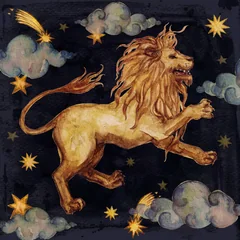
Having the Moon in Leo means you need to be seen in order to feel safe: without recognition, affection does not reach you, even when it exists. It is not vanity, although it gets read that way. It is that the other person's gaze is the channel through which this person receives.
Leo is fixed fire, ruled by the Sun. In a Moon, that produces a specific way of working: emotional comfort depends on mattering to someone explicitly. Love that goes unsaid does not feed this Moon — not because it doubts, but because its receiving channel is demonstration. People who love without saying so leave this person hungry beside a full table.
From there comes the need for recognition every text points at and almost none explains. It is not a craving for praise: it is that the Moon, in anyone's chart, calms down through what it recognizes as care — and in this position care is spelled with visible attention. The cost shows up when the attention is missing and they conclude, with no evidence, that they stopped mattering.
And there is a second piece almost no Moon text mentions: the Sun is the ruler of this Moon. The sign and the house of your Sun say on what ground this need to shine gets played out — and they are the first place where two Moons in Leo stop looking alike.
How Moon in Leo shows up in daily life
It shows up in the difference it makes, for this person, to be noticed by someone who matters. These are concrete signs, the kind you recognise in your own week:
- visibly improves when someone praises something they made with care
- generous in a large way: when they give, they give too much, and expect it to be seen
- being forgotten hurts them more than being criticized
- has pride: would rather solve it alone than admit they needed help
- dramatizes when not listened to, and is then embarrassed at having dramatized
- cheering others up calms them — making someone laugh is a way of self-regulating
Notice what that list does not say. It does not say the person is self-centred or dramatic by nature — two labels this position carries that describe the excess, not the position. It says where the emotion comes in.
What the strengths of Moon in Leo are
The strength is warm generosity: this person brightens the room by presence, and not by effort. Anyone who has been taken in by them remembers the warmth, and warmth is one thing you cannot fake.
In practice that turns into three useful things: giving recognition easily, because they know what it is worth and do not ration it; the loyalty of someone who has chosen, which is large and visible; and a real ability to lift whoever is down, because cheering up is their natural way of caring.
That strength pays off best with demonstrated affection, recognition said out loud and people who give back. And it does badly in a relationship with little demonstration, in a cold environment and in any arrangement where asking for attention is considered unseemly.
What the challenges of Moon in Leo are
There are two, and they are opposites: the excess is needing an audience even at home, and the deficiency is the person who dimmed themselves because standing out was frowned upon. The Shelly Method reads every archetype through four faces — the light, the shadow, the excess and the deficiency — and it is the last of them that almost no sign text mentions.
The excess is turning one's own emotion into the subject of the room: the discomfort that has to be noticed, the announced hurt, the dramatization that guarantees attention. It also shows up as wounded pride — the person disappears instead of saying they were hurt, and waits to be sought out as proof that they matter.
The deficiency is the opposite and hurts more: the person who grew up hearing that they thought too much of themselves, that they were too much, that they were trying to show off — and shrank. From outside they look modest and discreet. Inside there is a hunger for recognition they are ashamed to feel, and an embarrassed envy of anyone who gets attention without asking permission. It is Moon in Leo with no light.
Both faces have the same raw material, and that is why the repair is the same: a need for recognition that has to be asked for without shame. It is not solved by asking the person to be more humble. It is solved by their learning to say “I need you to see this” — and that is what the house of the Moon and the position of the Sun show.
Those two challenges do not show up the same way in two people with the Moon in Leo. What changes is the rest of the chart — the house the Moon is in, where the Sun landed, and what the Ascendant lets show.
See this in my chart, freeHow Moon in Leo evolves over time
It matures when the person discovers that asking for attention is not weakness — and that discovery is worth more than any attempt to need less. The attempt not to need almost always fails, and produces the deficiency described above.
There are two rhythms that help to understand the arc. The Moon goes around the zodiac in about twenty-eight days, so the emotional question comes back every month. And the Sun, the ruler of this Moon, returns to its exact birth position once a year — that is the astrological birthday, and for this position it works as an annual settling of accounts between what it gave and what it received.
Maturity here is not becoming discreet. It is the person starting to ask instead of signalling. A mature Moon in Leo goes on needing warmth, and starts naming that without going round in circles — and it is that frankness that turns pride into dignity.
No honest text gives an age for this. The arc depends on the whole chart and on the life the person had.
What Moon in Leo does not say about you
It does not say who you are, how you arrive, or how much of your warmth the rest of the chart lets out — and those three things change everything. The Moon is one piece of a system, and the easiest to misread when read alone.
If your Sun is an earth or a water sign — Virgo, Capricorn, Scorpio, Pisces —, a contained identity lives alongside an emotion that needs warmth and an audience. It is the serious person who, at home, wants applause — and finds herself ridiculous for it. See the Sun in Leo for the case in which both point the same way.
If your Ascendant is an earth or a water sign, this need to shine does not show at the door: the person arrives reserved, and only those who live with her find out how much she needs recognition. See the Ascendant in Leo for the contrast.
If the Sun is in a hard aspect to Saturn, the need for recognition comes with a shame at having it. It is the configuration that shows up most often in the deficiency described above. The Moon does not explain that. The Sun and Saturn do.
And there is the house of the Moon, which says in what area of life this need gets played out. The same Moon in Leo in the 5th house wants to be seen by her children and by what she creates, and in the 10th house wants to be seen by her work — the same emotion in two lives that do not look alike.
Add the aspects to that — Neptune square the Moon dissolves the outline of what this person wants, and she spends years shining for the wrong audience — and it becomes clear why two people with the same position may have nothing in common. The chart is a system: each piece alters the others.
A limit said out loud, because it is also part of reading seriously: none of this is a diagnosis. Astrology describes tendency and gives vocabulary for what the person already lives; it does not identify illness, does not decide for anyone and does not replace medical care.
Frequently asked questions about Moon in Leo
Do I need my birth time to know my Moon?
In most cases yes. The Moon changes sign every two and a half days, so anyone born on a turning day has two possible answers and only the time settles it. On days that are not turning days the date is enough — but you only find out whether that is your case by calculating the chart.
Is Moon in Leo self-centred?
Self-centredness is the excess of the position. What actually exists is a receiving channel: this person takes in affection through demonstration, and without demonstration the affection does not reach them even when it exists. It turns into self-centredness when attention starts being demanded instead of asked for.
Why does being forgotten hurt me more than being criticized?
Because criticism proves you were seen, and being forgotten does not. For this Moon, being noticed is the food itself — so criticism is uncomfortable and being forgotten is threatening. Knowing this helps: usually there was no contempt, there was distraction.
Does Moon in Leo need praise in order to function?
It needs recognition, which is broader than praise: it can be a thank you, a remembering, a choice. What this Moon cannot bear is the assumption that it knows it matters without anyone saying so — and couples who learn this settle half of their arguments.
Does Moon in Leo define my personality?
No. It gives the emotional need. Personality is the whole: the Sun, the Moon, the Ascendant, the planets, the houses and the aspects between them. A text that describes personality from the Moon alone is describing one twelfth of a person.
Moon in Leo in summary
Keywords recognition, warmth, generosity, neediness
This one cannot be found from the date: the Moon changes sign every two and a half days, more or less. Two people born on the same day can have different Moons — it depends on the TIME. Without a birth time there is no Moon, and that is why the chart asks for date, time and city. You can calculate it for free here.
See your whole chart, for free
Sun, Moon, Ascendant, the planets, the houses and the aspects calculated from your date, time and city of birth. It takes less than a minute.
Generate my birth chart for free Want the written reading of the whole? Personality and essence crosses Sun, Moon and Ascendant instead of describing each one separately.The Moon in the 12 signs
The Moon in the 12 houses
The Sun says where you become who you are; the Moon says where you run when the day goes wrong.